Saturday, 8 September 2012

Pakistan could Boycott ICC awards over Ajmal omission


PCB chairman Zaka Ashraf has reopened the debate surrounding Saeed Ajmal's exclusion from the ICC awards shortlists by hinting that Pakistan's players could boycott the awards function, to be held in Colombo on September 15, as a "robust protest". The ICC, responding to the PCB's protest on Monday, had ruled out a rethink and the matter seemed to have ended there.

However, Ashraf's comments, made during an interview to  suggest the issue is still alive for Pakistan. "We are facing a lot of pressure from the public and from our former players to push for his inclusion," Ashraf said. "I think the ICC should check whether the independent jury is coming up with the best name and they should not give away the due right of any player in the world.

"If anyone else has more wickets than Ajmal, then we are ready to withdraw our concern and instead we will support their pick. But this isn't reflecting well of the ICC and they should rectify it.

"Meanwhile we probably have to give a second thought to even boycott the function as a robust protest."

Ajmal was in the longlist for the Test Player of the Year award but missed out when an independent 32-member jury, which included former Pakistan captain Aamer Sohail and Pakistan journalist Majid Bhatti, nominated Sri Lanka batsman Kumar Sangakkara, South Africa fast bowler Vernon Philander, Australia captain Michael Clarke and South Africa opener Hashim Amla in that category.

Ajmal, 34, took 72 Test wickets between August 4, 2011 and August 6, 2012 - the qualifying period for the award - including 24 at 14.70 as Pakistan swept aside England, the then No. 1 side in the world, 3-0 in January. He has climbed to No. 3 in the ICC Test bowling rankings and is the highest ranked spinner. On Thursday, he was revealed as the top bowler in the ODI rankings.

After the PCB lodged the protest, the ICC refused to reconsider Ajmal's case, saying it had no authority to change the results of the academy. The process was monitored by the independent auditor Ernst & Young, and the longlist was prepared by a five-member Selection Panel headed by Clive Lloyd and included Clare Connor (England), Tom Moody (Australia), Carl Hooper (West Indies) and Marvan Atapattu (Sri Lanka).

Monday, 2 July 2012

Rain returns to hurt chances of result

Sri Lanka 70 for 1 (Dilshan 46*, Junaid 1-22) trail Pakistan 551 for 6 dec. (Hafeez 196, Ali 157, Misbah 66*, Herath 3-165) by 481 runs

Misbah-ul-Haq heaves on his way to an unbeaten 66, Sri Lanka v Pakistan, 2nd Test, SSC, Colombo, 3rd day, July 2, 2012Afternoon showers on day three put an outright result in serious doubt as only one session could be played out. In that session, Pakistan added 63 to their overnight 488 before declaring. In the next 70 minutes, Sri Lanka were put through a sterner test than the Pakistan openers, but they lost just one wicket.
Pakistan's quicks generated more response from the pitch than their Sri Lankan counterparts, but that didn't translate into too much success as Tillakaratne Dilshan rode his luck. An overnight declaration on 488 was a consideration because of the weather: 45 overs had already been lost on day two, and forecast for the rest of the Test wasn't the brightest either. However, Pakistan went for the scoreboard pressure, and declared only after they reached 550.
Pakistan didn't meander aimlessly, though: Misbah-ul-Haq went at a strike-rate of 82.50, much higher than his ODI career statistic, and Abdur Rehman hit two straight sixes in his 18 off 13. It took Pakistan little under an hour, and 12.4 overs, to score the 63 runs that took them past 550. In the process Misbah reached his 17th half-century, scoring 37 off 40 balls on the third morning. The fields were spread far out so he had to rely more on well-placed ones and twos as opposed to boundaries. Asad Shafiq and Adnan Akmal perished for the cause, but Rehman provided the required thrust with sixes off both spinners. Rangana Herath bowled one over fewer than a whole ODI innings.
Ten minutes later, with runs on board already, Pakistan made a spirited start with the ball. Aizaz Cheema and Junaid Khan bowled faster and hit the seam more often than the Sri Lankan bowlers. As a result, they bowled more threatening deliveries in one spell than Sri Lanka did in the whole innings. Cheema began with a short-of-a-length delivery that reared towards Tharanga Paranavitana's chest. Paranavitana never settled in, and was caught bat-pad to a Junaid delivery that seamed in. This was Paranavitana's seventh duck in his 28th Test, a high rate for a Test opener.
Tillakaratne Dilshan, at the other end, tried every trick in the book to get out, but the pitch and luck smiled on him benevolently. The seam movement in Junaid's first over seemed to have rattled him, and he hoicked at the last ball of that over; the leading edge fell straight of mid-on. Until lunch, Dilshan kept slashing and flashing, twice edging short of the cordon, once bisecting keeper and first slip. In Saeed Ajmal's first over, minutes before lunch, he survived a desperately close lbw shout when he was hit just above the knee roll bang in front and inside the crease. However, nothing stopped the aggressive Dilshan: he followed that lbw shout with two lofted fours, a response not too different to the rest of his innings. By lunch he had raced along to 46 off 54.
Kumar Sangakkara was much more reassuring for Sri Lanka, clipping the first ball he faced for four, and continuing to do so. The only moment of concern at Sangakkara's end arrived when he got a thick inside edge onto his pad, but it was too meaty for Azhar Ali at short leg to react in time.
No play was possible after lunch.

Friday, 22 June 2012

Kaneria to contest "unfair" ban


Danish Kaneria has confirmed he will appeal against the lifetime ban handed down to him by the ECB on Friday.
Kaneria, the Pakistan legspinner, called the decision "very unfair" and also attacked the evidence given against him by the team-mate he was judged to have groomed to take part in a betting scam - Mervyn Westfield.
When the three-man ECB disciplinary panel found Kaneria guilty of corruption, Gerard Elias QC called him "a grave danger to the game of cricket" and was highly critical of his defense arguments during the case heard in London.
Danish Kaneria at the Sindh High Court, Karachi, July 4, 2011Kaneria insisted that he was "an honest man" and that he would fight a decision that looks certain to end his career.
"I'm very upset about this decision," he told Sky Sports News. "For what reason they have convicted me I do not know. It is a very, very unfair decision against me. I've come all the way from Pakistan to say the truth.
Kaneria rejected the finding that he was a grave danger to the game. "They don't have any proof against me. I don't know why they are saying this. I will definitely be doing an appeal. The people trust me. I'm an honest man. I've been playing cricket with passion and love. I have done nothing wrong."
Westfield, the former Essex pace bowler, who was jailed for four months in January after accepting £6000 to conceded a set number of runs in an over during the Pro40 match against Durham in 2009, gave key evidence during the hearing. That earned him some latitude with Elias when he was given a five-year ban from the game which the allowance of being able to play club cricket in three.
However, Kaneria hit back: "The person who has committed the crime, gone to prison, been telling lies to police, telling lies in court - he has told lies even in the tribunal," he said. "I'm not lying. I'm telling the truth. I've been telling the truth all the way."
As well as the appeal that Kaneria has said he will launch there is also an ongoing integrity committee hearing with the PCB which is now set to conclude following the end of the ECB case. Although the ban was only handed out by one member board, the ICC expect the sanctions against Kaneria to be accepted around the world.
Haroon Lorgat, the ICC chief executive, said: "I will ask the Board to remind all Members to put in place appropriate mechanisms to ensure that the sanctions imposed on both players in this case are appropriately recognised and respected outside of the ECB's domestic jurisdiction
"The need to protect the game from corruption requires every one of us, including the players, to remain vigilant and work tirelessly to that end. The increased popularity and television coverage for various domestic competitions around the world requires much more than just the ICC to be vigilant and we acknowledge the ECB's efforts in this respect."

Tuesday, 19 June 2012

'Amir must return to cricket more focused' - psychologist


Mohammad Amir outside the Southwark Crown Court, London, November 2, 2011Maqbool Babri, the psychologist working with banned Pakistan fast-bowler Mohammad Amir, has said that he is looking to make him more focussed so that he can return to cricket after his rehabilitation process and be "an example".
Babri, who was hired by the PCB to work with Amir, told that his client had already acknowledged where he went wrong and wanted to put the past behind him. "He is an exceptional cricketing talent," Babri said. "He admitted his mistake and paid a lot for it. He must return to cricket to be a living example for the cricketing world, or people might forget about his talent.
"He understands cricket is a profession. He is in good shape - in control and surprisingly positive - and is very passionate about cricket. But he needs to be focussed and I will help him get into the right frame of mind."
The ICC had banned Amir, 20, for five years after he was found guilty of spot-fixing during a Test at Lord's in 2010. He spent three months in a British juvenile detention centre, before being released in February. The ICC had also banned Mohammad Asif and captain Salman Butt for the same offence.
"The scenario for Amir is unique because he is still young and has plenty of time ahead of him, even after he completes his five-year ban," Babri, who had also counseled the likes of Umar Akmal, Ahmed Shahzad and Zulqarnain Haider in 2009 before the World Twenty20, said. "I don't feel the same about Salman and Asif, their career might be over before their ban ends. Everyone makes mistakes and people are jailed for their reform. It is the action that needs to condemned, not the person. Amir is an interesting person and has been very well groomed as a cricketer."

Mathews gem seals series for Sri Lanka


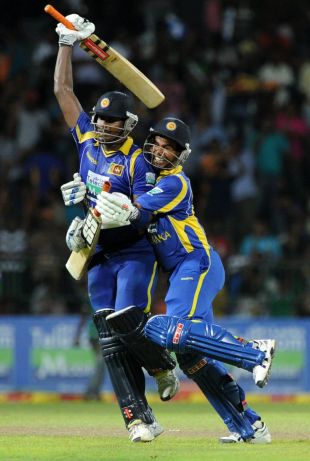
Angelo Mathews and Nuwan Kulasekara celebrate a hard-fought victory, Sri Lanka v Pakistan, 5th ODI, Premadasa Stadium, Colombo, June 18, 2012Sri Lanka 248 for 8 (Mathews 80*, Chandimal 54, Tanvir 3-42) beat Pakistan 247 for 7 (Farhat 56, Akmal 55*, Mendis 2-30) by two wickets
Pakistan's journey to defeat in the final game that decided the series was an emotional ride, which had several moments of satisfaction and relief, but ultimately ended in frustration and regret. The satisfaction was because of a significantly improved batting performance that cast aside memories of a dispiriting collapse in the previous ODI, they experienced relief after wriggling out of difficult situations they'd created, the brief-but costly-spells of wayward bowling were a source of frustration, but the emotion that will linger will be the regret of an insipid fielding display that undermined each forward step. Amid all this, Angelo Mathews was a figure of calm and assuredness, and not for the first time he rescued Sri Lanka from trouble and fashioned a thrilling victory with the tail. 
Not quite the "tail", since Sri Lanka's No. 9 - Jeevan Mendis - has nine first-class hundreds. Nuwan Kulasekara did his bit too, but Mathews' presence was the key. With his team on 138 for 6 in the 35th over, Pakistan were the favourites. Mathews didn't flinch. He was selective in the balls he picked to dispatch, displayed confidence in his lower-order team-mates, indulged in a lot of touch-play and placement to work the gaps, all the while reminding his opponents that his was the decisive wicket.

Those reminders weren't enough to prevent Pakistan from letting their guard down. Outfielders failed to prevent twos that should have been ones, and those inside the circle failed to run the batsmen out at least three times, missing their targets as the chase approached a thrilling end.
With 12 needed off five balls, Mohammad Sami - replacing the "rested" Saeed Ajmal - bowled a juicy length ball that Mathews launched over long-on. Another poor throw and two runs later, with four needed off three, Mathews cracked a short ball over point to seal the win.
There had been several mini-conferences between overs, parallel discussions between fielders, all summing up Pakistan's struggle to close the lid despite climbing to positions of advantage. The run-outs of Thisara Perera and Lahiru Thirimanne deprived Mathews of two capable partners, but Pakistan were in for a surprise soon when Mathews ceded floor to Mendis, who kickstarted the counterattack.
Just when the required-rate had gone past nine an over in the 44th, Mendis smashed Sohail Tanvir's slower ball for six over long-on before driving and glancing Umar Gul for two boundaries. Tanvir eventually got rid of Mendis, but Kulasekara hung on, even collecting a fortuitous boundary past third man off Sami. The pair of Kulasekara and Mathews knocked off six singles in the penultimate over, leading up to Mathews' final surge in the 50th that included another missed run-out.
While poor ground-fielding produced the reprieves towards the end of the innings, it combined with poor catching in the first half. Misfields and a ball kicked for four in the outfield preceded a straightforward catch dropped off Kumar Sangakkara on 25 by wicketkeeper Sarfraz Ahmed. The run that lapse conceded brought about a half-century stand between Sangakkara and Dinesh Chandimal. It had helped Sri Lanka recover from two early blows inflicted by Tanvir, who castled Tillakaratne Dilshan and Upul Tharanga. Even though Sarfraz reacted sharply to run out Sangakkara for 36, the Pakistani heads continued to sink in their hands as the fielding woes didn't stop.
Chandimal, too, was given a life on 35 when a mistimed pull off Gul in the 30th over was put down by Azhar Ali at deep square leg. Ali was several yards in and failed to hold on as he back-pedalled and was unable to keep his balance. Chandimal went on to score a further 19 runs, those extra runs proving a major contribution in the outcome.
Pakistan replaced an experienced Younis Khan with Imran Farhat, who opened the batting and delivered to make a fluent fifty, with shots relying heavily on wristwork and backed up with flourish. He built a solid partnership with Ali, who then formed a steady association with Asad Shafiq. Each of the three batsmen, however, gave their wickets away - Farhat and Ali were caught off avoidable shots while a moment's hesitation for a single accounted for Shafiq.
Umar Akmal gave the innings impetus with his attacking, unbeaten 55. He thrice flicked Lasith Malinga past short fine, struck Perera for two sixes and promised to take Pakistan past 260. At 220 for 6 in the 44th over, that was well within reach. Akmal was picking Malinga's slower ones, but that changed soon as the seamer got his yorkers on the mark. Akmal made room, moved across, swung hard, tried to scoop, but Malinga had the better of the contest at the death. His thrift ensured Akmal managed only nine runs off his last 19 balls, and Pakistan just 27 off the last six overs. It would hurt Pakistan in the end, but not as much as their fielding.

Fewer ODIs likely in Pakistan-Australia series


Pakistan's home series of limited-over games against Australia is likely to be reduced to a mix of three ODIs (instead of five ODIs) and three Twenty20 internationals, with the UAE remaining the most likely venue. Plans for more Twenty20 games - as reported by yesterday - have come unstuck because of a time crunch to get the ICC's approval as required.
Brett Lee gave Australia hope with two wickets in two balls, Australia v Pakistan, Group A, World Cup 2011, Colombo, March 19, 2011The series, according to PCB sources, will be held after the month of Ramadan, which ends on August 18; giving both teams practice ahead of the World Twenty20 in Sri Lanka, which begins on September 18. To beat the summer heat, the matches are likely to be held in the late evening, with the ODIs starting at 5 pm and the Twenty20 games at 7 pm.
"Plan is to play three ODIs and three T20Is," Intikhab Alam, the PCB's director for international operations, told reporters on Wednesday. "I have given my assessment reports about both venues [UAE and Malaysia] and the announcement will be made within this week."
Any Twenty20 series comprising more than three matches requires the ICC's permission; though the idea of a five-game series is open for discussion in the ICC Executive Board meeting later this month, formal approval might take some more time - which the boards don't have.
"We've always said to Pakistan this is your home, come and play when you want to and we make it cost-effective for them," Dilawar Mani, the chief executive of the Emirates cricket board, told . "Yes it's going to be hot and humid, but heat is not as much of an issue as the humidity is."
"Humidity will be a factor, so we proposed a start later in the evening instead of 3 pm for ODIs," added Mani.
"We usually arrange late starts for our domestic tournament during Ramadan and I don't see any logistical problem there," he said. "In fact, arranging matches in evening works better - we can pull in bigger crowds as the offices close around 4 pm. So people can easily turn to the stadium after finishing their work."
Sri Lanka had originally emerged as a likely venue for the Pakistan-Australia series, but withdrew when it became apparent that the dates would clash with the Sri Lanka Premier League. Alam visited Malaysia and the UAE to assess options and, though weather is an issue in both places in August, the possibility of rain in Malaysia goes against it. Though the monsoon season is at its peak from November to February in Malaysia, August proves to be the wettest month on the west coast and could disrupt the series.


Monday, 18 June 2012

Stunned Pakistan seek to save series


Match facts
Monday, June 18
Start time 1430 (0900 GMT)

Younis Khan was the first of Thisara Perera's hat-trick victims, Sri Lanka v Pakistan, 4th ODI, Colombo, June 16, 2012

Big Picture
Pakistan's batsmen deprived their team of a chance of winning the series, collapsing to lose seven wickets for 13 runs after reaching a position of advantage in the chase in the fourth ODI. An implosion of that nature can be dispiriting, the painstaking yet determined progress by their captain and an emerging top-order talent decimated by the ineptness of those followed. Not too long ago, in 2009 in Sri Lanka, such collapses cost Pakistan the Test series; they have another game to get their batting in order before the Tests.
That's if the weather permits them, though there's the insurance of a reserve day. The balance of power has shifted from spin to pace in the Sri Lankan bowling line-up, and the hosts' seamers have shown there's sufficient ammunition to defend a competitive score. Their batting has improved significantly, led by their experienced trio, after a forgettable performance in the rain-affected first ODI. Sri Lanka are a team on a high; Pakistan, with some sloppy fielding and misfiring batting, not so.
This Premadasa track is not the one that made the venue a fortress of sorts for the home team in the previous couple of decades. They face a good bowling unit but Pakistan's batsmen have a bigger challenge - that they don't end up becoming their own biggest threat.
Form guide

Sri Lanka WWLLL (Completed games, most recent first)
Pakistan LLWWL

Watch out for...
When he first began making a mark as an opener, Mohammad Hafeez's problem was that he squandered good starts, playing a false shot after settling in well. On this tour so far, he's struggled to get even the starts, with three ducks, two of them consecutive. His offspinners have been economical, but he isn't doing justice to the sound technique and solidity he usually offers with the bat.
Upul Tharanga has had a quiet series so far, with scores of 10, 18 and 4. He's just as much in need of a push; if picked tomorrow, he'll play his 150th ODI.
Team news
Sajeewa Weerakoon will think he's done enough to retain his place in the XI, picking up 1 for 49 with his left-arm spin. Sri Lanka could remain unchanged.
Sri Lanka (possible): 1 Upul Tharanga, 2 Tillakaratne Dilshan, 3 Kumar Sangakkara (wk), 4 Mahela Jayawardene (capt), 5 Dinesh Chandimal, 6 Lahiru Thirimanne, 7 Angelo Mathews, 8 Thisara Perera, 9 Nuwan Kulasekara, 10 Lasith Malinga, 11 Sajeewa Weerakoon.
Umar Gul received treatment on the ring finger of his right hand during the fourth ODI. He was impressive at the start, but faltered in the batting Powerplay. For reasons of injury, or otherwise, Pakistan have Mohammad Sami to fall back on; he's recovering from a thumb injury himself.
Pakistan (possible): 1 Mohammad Hafeez, 2 Azhar Ali, 3 Asad Shafiq, 4 Younis Khan, 5 Misbah-ul-Haq (capt), 6 Umar Akmal, 7 Shahid Afridi, 8 Sarfraz Ahmed (wk), 9 Sohail Tanvir, 10 Umar Gul/Mohammad Sami, 11 Saeed Ajmal.
Stats and trivia
  • This year has been an expensive one for Umar Gul in ODIs. He's taken 15 wickets at 35.06 - his worst in a year - and has gone for 5.71 an over. His worst year, in terms of economy-rate, was 2010, when he went for 6.25 an over.
  • Among players who've scored more than 2500 runs in ODI cricket and not scored a single century, Misbah-ul-Haq has the highest average - 42.30